
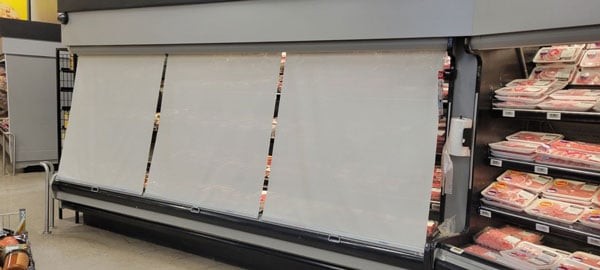
Store managers need practical tools they can use today to prove the value of night covers. This DIY calculator helps you estimate hourly, daily, and annual energy and cost savings from installing night covers on open refrigerated display cases. Use it to build a business case, qualify for utility rebates, or justify a pilot at a single-store level.
What the calculator estimates
- kWh saved per hour the night cover is deployed
- Daily kWh and cost savings (based on hours covered per day)
- Annual savings and payback time (using night cover cost)
- Simple scaling for multiple cases
Inputs you need (measure these for accuracy)
- Baseline case power draw (W) — measured with a clamp meter or taken from equipment specs (example: 4,000 W per open case).
- Average % energy reduction when covered — conservative range: 36%–50%. Use site test data if available (e.g., 40%).
- Hours covered per day — e.g., 10–14 hours (overnight plus cleaning time).
- Electricity rate ($/kWh) — from your utility bill (e.g., $0.12/kWh).
- Number of cases covered — how many open cases you’ll install covers on.
- Installed cost per case — purchase + installation (or motorized upgrade).
- Any rebate amount per case — if available from utility programs.
The formulas (copy-paste friendly)
Let:
P = Baseline case power draw in watts (W)
R = Energy reduction fraction (e.g., 40% → 0.40)
H = Hours per day cover is deployed (hours)
C = Electricity cost ($/kWh)
N = Number of cases
Cost_per_case = Installed cost per case ($)
Rebate_per_case = Utility rebate per case ($)
- kW saved per hour per case = (P / 1000) × R
- Daily kWh saved per case = (kW saved per hour per case) × H
- Daily $ saved per case = Daily kWh saved per case × C
- Annual $ saved per case = Daily $ saved per case × 365
- Annual $ saved for N cases = Annual $ saved per case × N
- Net installed cost after rebates per case = Cost_per_case − Rebate_per_case
- Payback period (years) = Net installed cost per case / Annual $ saved per case
Spreadsheet-ready example formulas:
A2 (kW saved/hr) = (P/1000)*R
A3 (Daily kWh) = A2*H
A4 (Daily $) = A3*C
A5 (Annual $) = A4*365
A6 (Total annual for N) = A5*N
A7 (Payback yrs) = (Cost_per_case − Rebate_per_case) / A5
Worked example — show your math digit-by-digit
Assume:
P = 4,000 W (4,000 watts per open case)
R = 0.40 (40% energy reduction)
H = 12 hours per night cover usage
C = $0.12 per kWh
N = 10 cases
Cost_per_case = $600
Rebate_per_case = $100
Step 1 — kW saved per hour per case:
P/1000 = 4,000 / 1,000 = 4.0 kW.
kW saved/hr = 4.0 × 0.40 = 1.6 kW saved per hour.
Step 2 — Daily kWh saved per case:
1.6 kW × 12 hours = 1.6 × 12 = 19.2 kWh per day.
(Work: 1.6×10 = 16.0; 1.6×2 = 3.2; 16.0 + 3.2 = 19.2)
Step 3 — Daily $ saved per case:
19.2 kWh × $0.12/kWh = $2.304 per day.
(Work: 19.2×0.1 = 1.92; 19.2×0.02 = 0.384; 1.92 + 0.384 = 2.304)
Step 4 — Annual $ saved per case:
$2.304 × 365 days = $840.96 per year.
(Work: 2.304×300 = 691.20; 2.304×60 = 138.24; 2.304×5 = 11.52; 691.20+138.24+11.52 = 840.96)
Step 5 — Annual $ saved for N = 10 cases:
$840.96 × 10 = $8,409.60 per year.
Step 6 — Net installed cost per case after rebate:
$600 − $100 = $500 per case.
Step 7 — Payback period:
Payback (years) = $500 / $840.96 = 0.5949 years ≈ ~7.1 months.
(Work: 500 / 840.96 ≈ 0.5949; 0.5949×12 ≈ 7.14 months)
Conclusion from example: even with conservative assumptions, payback is under a year for this store and scale.
Tips to improve calculator accuracy
- Measure real power draw (P) with a clamp meter on a warmed-up case during typical operating conditions. Don’t use compressor start-up spikes — use steady run watts.
- Run an A/B test: measure case energy for several nights with no cover vs. nights with covers to get your site-specific R value.
- Account for varying hours: some stores deploy covers for 10 hours, others for 14; use the average.
- Factor in labor savings if switching to motorized covers—this increases ROI.
- Include shrink reduction: if you can measure reduced product loss (e.g., fewer spoiled cases of produce), add that annual dollar saving to the numerator when calculating payback.
How to present the result to stakeholders
One-page summary with the estimated annual $ savings per store and chain-level savings.
- Show payback period and highlight rebate sources.
- Add non-monetary benefits: reduced shrink, improved shelf life, lowered carbon footprint (link to your sustainability KPIs).
Tools & next steps
Use the Night Covers ROI Calculator at RamiCovers for an automated version.
Explore product options (reflective, woven, motorized) and rebate info at: www.ramicovers.com and www.ramicovers.com/rebates.
Pilot one store, collect real usage data, then scale using the single-store → multi-site path.
Quick checklist for store managers
- Measure per-case run watts (P).
- Set realistic % savings (R) from pilot or use 36–50% range.
- Choose hours per day covered (H).
- Get electricity rate from the latest bill (C).
- Count how many cases (N) will be covered.
- Check rebate eligibility and include Rebate_per_case.
- Run the spreadsheet, present payback & annual savings.
Final CTA
Explore more at www.ramicovers.com to match covers to your case types