
In today’s competitive retail environment, supermarkets and grocery stores must balance rising energy costs, food waste reduction, and sustainability goals. One technology that consistently delivers results across all store formats is night covers for refrigerated display cases. Whether it’s a single neighborhood store or a large chain with multiple sites, night covers—such as the Econofrost 9000 Series night covers or woven aluminum night covers—offer measurable energy savings, extend product shelf life, and protect inventory during unexpected outages.
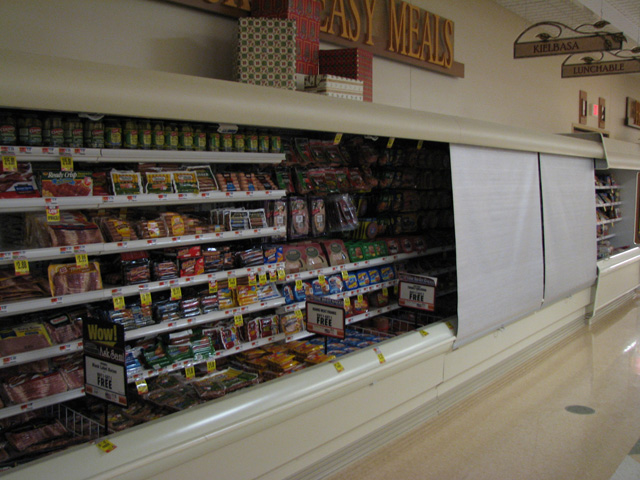
But when retailers consider adoption, the question often arises: Is it better to start small with a single-store rollout or invest in a multi-site deployment from the beginning? This blog explores the benefits, challenges, and return on investment (ROI) of both approaches while showing how to scale night cover programs effectively across regions and store formats.
Understanding Night Covers and Their Role
Night covers are retractable barriers—made from materials such as reflective aluminum or woven aluminum—that are pulled over open refrigerated display cases during non-operating hours. Acting as a thermal barrier, these covers prevent cold air from escaping and warm air from entering the case.
Key benefits include:
- Energy savings of 36%–50% per hour in open cases.
- Extended shelf life for fresh produce, dairy, meat, deli, and floral items.
- Power outage protection by keeping cases colder for longer.
- Lower refrigeration load, which reduces compressor strain.
- Support for sustainability goals by cutting carbon emissions.
Learn more about installation and models by visiting www.ramicovers.com.
Single-Store Rollouts: Testing the Waters
For independent grocers or regional retailers, a single-store rollout can be a cost-effective way to evaluate the performance of refrigerated display case night covers.
Benefits of a Single-Store Approach
- Lower upfront investment – Retailers can retrofit a single store with energy-saving refrigeration night covers to gauge performance.
- Data-driven decisions – Track metrics such as night covers energy savings, product shrink reduction, and ROI using the night covers ROI calculator.
- Staff training opportunity – Store employees can learn night covers installation and maintenance procedures, improving operational efficiency.
- Outage testing – During power interruptions, single-store trials prove the emergency response capability of night covers.
Challenges of Single-Store Rollouts
- Limited impact – Energy savings and food preservation benefits are confined to one location.
- Slower payback – A single-store test may delay chain-wide cost reductions.
- Rebate limitations – Some utility rebate programs require large-scale adoption for maximum incentives.
Single-store rollouts work well for independent supermarkets or as a proof-of-concept within larger chains.
Multi-Site Rollouts: Scaling for Maximum ROI
For larger supermarket chains, wholesale clubs, or convenience store networks, a multi-site rollout delivers significant advantages.
Benefits of Multi-Site Deployment
- Massive energy cost reduction – Implementing supermarket refrigeration night covers across dozens of locations results in dramatic chain-wide savings.
- Standardization – Consistent use of hygienic night covers for retail ensures uniform food safety standards.
- Utility rebate maximization – Multi-site adoption qualifies for larger energy efficiency rebates.
- Economies of scale – Bulk purchasing of 9000 Series night covers, 9600 Series night covers, or motorized night covers reduces per-unit cost.
- Sustainability reporting – Companies can include carbon footprint reductions from night covers in corporate ESG metrics.
Challenges of Multi-Site Rollouts
- Higher upfront costs – Retrofitting multiple stores requires more capital investment.
- Logistical complexity – Coordinating night covers installation across regions requires planning.
- Training needs – Multi-site rollouts demand consistent training for store managers and staff.
Despite these challenges, multi-site rollouts deliver the fastest ROI and greatest sustainability impact for large-scale retailers.
Comparing ROI: Single-Store vs. Multi-Site
Night Covers ROI Factors
- Energy savings per case per hour
- Shrink reduction from extended shelf life
- Lower labor costs from fewer restocks
- Emergency protection during outages
- Eligibility for rebates and incentives
Example
- A single-store retrofit with 40 open cases using woven aluminum night covers may save $20,000 annually in energy and shrink.
- A chain of 50 stores with the same retrofit could save $1 million+ annually, making payback nearly immediate.
Using the night covers ROI calculator, retailers can project savings for both scenarios. Visit www.ramicovers.com to explore ROI tools and options.
Scaling Strategies for Night Cover Programs
Whether you start with one store or many, scaling is essential to maximize impact.
Step 1: Conduct a Pilot Test
Install retrofit night covers in one or two stores. Collect baseline data on:
- Energy cost reduction refrigerated cases
- Shrink reduction
- Shelf life extension
Step 2: Evaluate Performance:
Measure performance across produce cases, dairy cases, meat cases, deli cases, and freezer cases. Assess results by region (e.g., hot vs. cold climates).
Step 3: Expand to Multi-Site Rollout
Use the pilot results to secure funding for chain-wide adoption. Ensure installation guides and replacement parts are standardized across locations.
Step 4: Integrate with Energy Management Systems
For large rollouts, consider motorized night covers integrated with energy management platforms for automated scheduling and reporting.
Step 5: Report on Sustainability
Highlight carbon savings, shrink reduction, and customer satisfaction in ESG reports.
Night Covers Across Regions
Scaling programs also depends on geographic performance:
- Cold climates – Reflective aluminum night covers prevent case frosting and maintain efficiency.
- Hot climates – Woven aluminum night covers provide stronger thermal protection and reduce HVAC interaction.
- Urban stores – Motorized night covers ensure compliance with strict energy codes.
- Rural stores – Manual night covers offer low-cost solutions for small retailers.
These differences prove that night covers are versatile across climates and store formats.
Conclusion
What’s clear is that the earlier retailers adopt, the faster they benefit from energy savings, shrink reduction, and sustainability performance.
If you’re ready to explore night covers for open refrigerated cases, visit www.ramicovers.com to learn more about installation guides, performance data, ROI calculators, and rebate eligibility. Equip your store—or your entire chain—with the industry’s most reliable energy-saving refrigeration night covers, and start scaling savings today.